Inkjet Coders and the Future of Industrial Product Marking
Inkjet coding has become a cornerstone of modern manufacturing. What was once a specialist technology is now a critical production tool across food, beverage, pharmaceutical, personal care, industrial, and consumer goods sectors.
From high-speed beverage lines coding thousands of bottles per minute to pharmaceutical packaging that demands absolute accuracy and compliance, industrial inkjet coders deliver the speed, precision, and reliability manufacturers depend on every day.
Understanding how inkjet coding works, where it adds value, and how to implement it correctly is essential for any manufacturer looking to improve efficiency, maintain compliance, and protect brand reputation in increasingly regulated and competitive markets.
The Evolution of Inkjet Coding Technology
Industrial inkjet coding has evolved significantly over the past few decades. Early systems were often sensitive, labour-intensive, and required specialist attention. Today’s inkjet coders are robust, automated, and designed for continuous operation in demanding production environments.
Continuous Inkjet (CIJ) Technology
Continuous inkjet coding is the most widely used inkjet technology for industrial marking, particularly on non-porous substrates. CIJ printers generate a constant stream of ink droplets, which are electrically charged and precisely deflected to form characters on moving products.
This non-contact printing method makes CIJ ideal for:
- High-speed production lines
- Curved or uneven surfaces
- Glass, plastic, metal, and coated substrates
- Environments where physical contact is impractical
CIJ remains the preferred choice for beverage bottles, cans, pharmaceutical packs, automotive components, cables, and electronics.
Thermal Inkjet (TIJ) Technology
Thermal inkjet systems operate differently, using controlled heat to eject ink droplets only when required. TIJ is particularly effective for high-resolution printing on porous materials such as cartons, paperboard, and corrugated packaging.
While TIJ serves specific applications well, CIJ remains the dominant technology for high-speed, non-porous product coding.
How Industrial Inkjet Coders Work
A clear understanding of inkjet coding principles helps manufacturers select the right solution and optimise performance.
In a CIJ system, ink is pumped under pressure through a fine nozzle to form a continuous stream. This stream is broken into uniform droplets using piezoelectric vibration. Individual droplets are electrically charged and then deflected by electrostatic plates to form characters on the product surface. Uncharged droplets are collected and recycled back into the system.
This process happens at extremely high speed, often generating tens of thousands of droplets per second, allowing clear, consistent codes even on fast-moving production lines.
Modern inkjet coders also include:
- Automated ink viscosity control
- Continuous ink filtration and circulation
- Intelligent monitoring of temperature, pressure, and droplet formation
- Predictive alerts to prevent print quality degradation
These features ensure stable performance over long production runs with minimal operator intervention.
Key Capabilities of Modern Inkjet Coding Systems
Today’s industrial inkjet printers are designed to meet a wide range of marking and traceability requirements.
Substrate Versatility
Inkjet coders can mark virtually any material found in manufacturing, including:
- Plastics such as PET, HDPE, PP, and PVC
- Glass bottles and jars
- Aluminium and steel
- Coated and uncoated cardboard
- Paper, wood, and construction materials
Correct ink selection ensures strong adhesion, fast drying, and long-term durability.
High Speed Performance
Modern CIJ inkjet coders can operate at line speeds exceeding 600 metres per minute, making them suitable for the most demanding applications in food, beverage, and pharmaceutical production.
Multi-Line and Variable Data Printing
Inkjet coding systems support up to six lines of text and complex variable data, including:
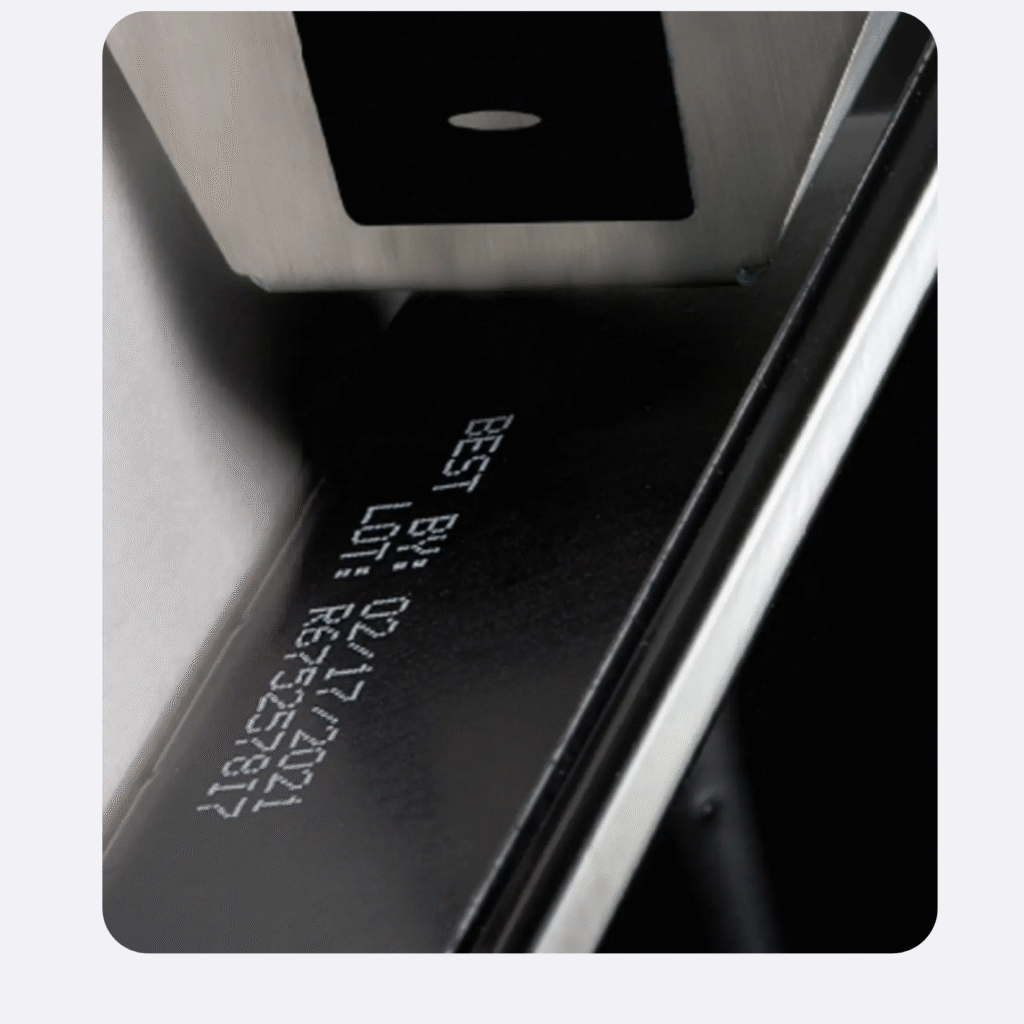
- Production and expiry dates
- Batch and lot numbers
- Serialisation and track and trace data
- Barcodes and 2D Data Matrix codes
- Logos, symbols, and regulatory information
Each product can receive unique information without slowing production.
Barcode and QR Code Printing
Accurate barcode printing enables automated scanning across supply chains. Inkjet coders reliably produce linear barcodes, Data Matrix codes, and QR codes for logistics, compliance, and consumer engagement.
Industrial Applications Across Key Sectors
Food and Beverage Manufacturing
Inkjet coders are essential in food and beverage production for date coding, batch identification, and traceability. High-speed performance and consistent print quality are critical for compliance, recalls, and brand protection.
Pharmaceutical and Healthcare
Pharmaceutical coding demands absolute reliability. Serialisation, batch numbers, and expiry dates must be accurate and legible at all times. Inkjet coding systems play a vital role in regulatory compliance and anti-counterfeiting strategies.
Personal Care and Cosmetics
Cosmetic and personal care products require discreet, high quality coding that does not compromise packaging aesthetics. Inkjet technology delivers clear codes on a wide range of materials while maintaining premium presentation.
Industrial and Manufacturing Components
Automotive parts, electronics, cables, pipes, and construction materials rely on durable inkjet marking for traceability, quality control, and lifecycle identification.
Advanced Features in Modern Inkjet Coders
Recent innovations have significantly improved usability and reliability.
- Automated printhead cleaning reduces maintenance
- Extended run times minimise production interruptions
- IP65-rated protection ensures reliability in harsh environments
- Intuitive touchscreen interfaces simplify operation
- Network connectivity supports Industry 4.0 integration
- Built-in diagnostics enable predictive maintenance
These features reduce the total cost of ownership while improving production uptime.
The Importance of Expert Implementation
Inkjet coding success depends on more than just hardware. Correct system selection, ink validation, installation, and ongoing support are critical.
Working with experienced specialists ensures:
- Correct ink formulation for each substrate
- Optimised printhead positioning
- Compliance with industry regulations
- Seamless line integration
- Comprehensive operator training
In the UK, Newcode is the primary distributor for Hitachi industrial inkjet printers, supporting manufacturers across food, beverage, pharmaceutical, personal care, and industrial sectors. Their application expertise, factory-trained engineers, and rapid on-site support help ensure consistent, compliant, and reliable coding performance.
Return on Investment and Business Value
Industrial inkjet coders deliver measurable value through:
- Reduced downtime and maintenance
- Lower consumable waste
- Improved traceability and compliance
- Enhanced supply chain efficiency
- Protection against recalls and regulatory penalties
For high-volume production environments, these benefits often deliver payback within one to two years.
Conclusion
Inkjet coders have become an essential part of modern manufacturing infrastructure. Their ability to deliver high-speed, non-contact, reliable marking across a wide range of substrates makes them indispensable for product identification, compliance, and traceability.
When advanced inkjet technology is combined with expert application knowledge and responsive support, manufacturers gain a robust, future-proof coding solution that supports efficiency, quality, and competitive advantage.